
The Edge Problem:
Why Most Binoculars Go Soft Where It Matters

"That's not a tracking problem. That's an edge problem. And it's worth understanding what's actually happening out there in the periphery of your view"
Dusk. The tree-line across the marsh has gone gray-green, the light almost gone. Something moves. Not in the center of your view — out near the edge, where the branches get complicated. A shape, a flutter.
You swing toward it. By the time it reaches the center of the frame, it's gone. You're not sure what happened. Maybe it flushed. Maybe it slipped behind the willows.
Or maybe the glass lost it before you did.
That's not a tracking problem. That's an edge problem. And it's worth understanding what's actually happening out there in the periphery of your view — because the difference between glass that holds and glass that doesn't is the difference between noticing and missing.
Most binoculars blur at the edges because of a fundamental property of how lenses focus light. When light passes through a curved lens, it converges toward a focal point — but that focal point isn't flat. It traces a curve called the Petzval surface. The center of the image lands sharp on that curve. The edges, angled farther from the optical axis, land somewhere else. The result is field curvature: a lens system that's optimized for the center at the expense of everything around it. Most binoculars don't correct for it fully, because correction requires additional lens elements, precise engineering, and cost. Edge blur, in most glass, isn't a defect. It's a design consequence.

"Even when a lens is fully corrected for coma aberration and astigmatism, the light rays arriving from off-axis points still focus at a plane that isn't perpendicular to the optical axis"
Why Lenses Curve the World
Light bends when it passes through glass. That's the whole point. But the geometry of a curved lens means incoming light at different angles — the ray coming straight through the center versus the ray arriving at a steep angle from the periphery — doesn't land at the same focal depth.
Nikon's optical engineering documentation describes it this way: even when a lens is fully corrected for coma aberration and astigmatism, the light rays arriving from off-axis points still focus at a plane that isn't perpendicular to the optical axis. That curved focal plane — the Petzval surface — is a property of the optical math. It isn't caused by poor manufacturing. It's built into the geometry of how glass bends light.
This matters more in wide-field binoculars than in narrow ones. A wider field of view pulls in light at steeper off-axis angles, which means the Petzval surface curves more dramatically relative to the image plane. The edge problem gets harder to solve the wider you build the view — which is exactly the design space where tracking animals across a landscape matters most.

What Edge Blur Actually Costs You
The sharp center of a blurry-edged binocular is easy to appreciate in a store. Raise the glass, look at something in the middle, nod. It looks great.
The cost comes in the field.
When you're scanning a ridgeline or panning across a marsh, your subject isn't always centered. Birds move fast. Deer hold at the margin of a meadow, not the middle. The animal that was in your center two seconds ago is at the edge now, blurring, while you re-center. Every re-centering costs you a fraction of a second. Over a long morning of glassing, those fractions add up to fatigue — not physical tiredness, but the low-grade mental strain of always chasing sharpness across the frame.
There's also a disorientation effect. Binoculars with pronounced edge blur, when panned, can produce what's sometimes called the globe effect or rolling ball effect — a sense that the image is rolling over a convex surface as you sweep. The visual system expects the world to stay coherent while you pan; when the edges smear differently than the center, the brain has to compensate, and that compensation has a cost. Some users notice it immediately. Others chalk it up to general discomfort and don't connect it to the glass.

"More elements, when well-designed, mean more opportunities to correct compounding aberrations across the full frame."
How Field Flatteners Work
Correcting field curvature means adding optical elements that bend the focal plane back toward flat. A field flattener lens — or, in more sophisticated systems, a multi-element field-flattening group — is designed specifically for this job. It doesn't add magnification or change the image in any apparent way when it's working right. It just holds the sharpness out to the edges.
The engineering challenge is that field flatteners interact with other aberrations. Correcting field curvature alone is straightforward; correcting it simultaneously with astigmatism and coma — the other aberrations that degrade peripheral sharpness — requires a more complex solution. That's why the number of optical elements in a binocular's system is a meaningful indicator: more elements, when well-designed, mean more opportunities to correct compounding aberrations across the full frame.
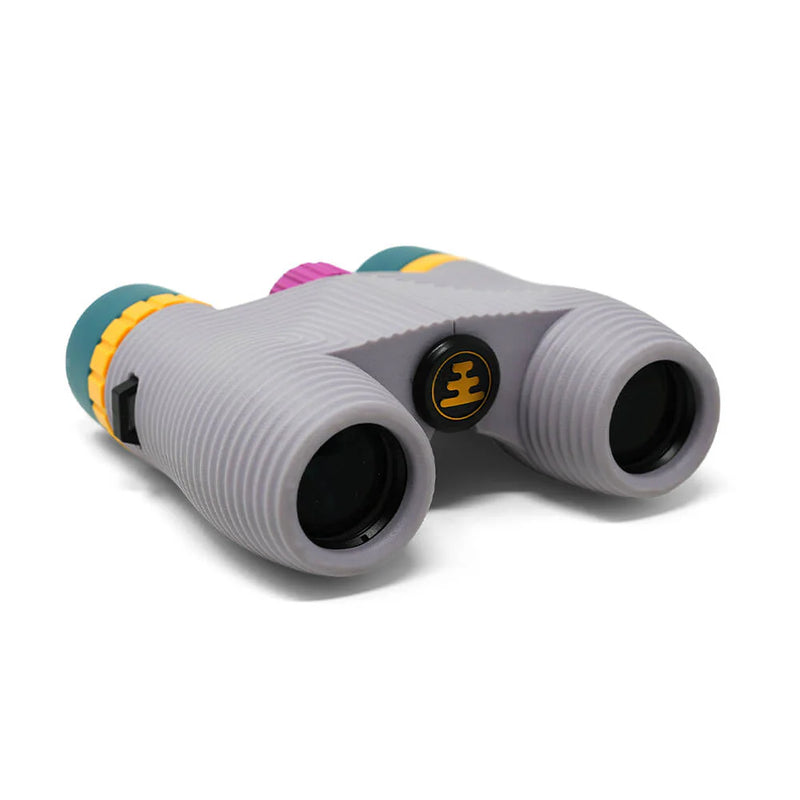
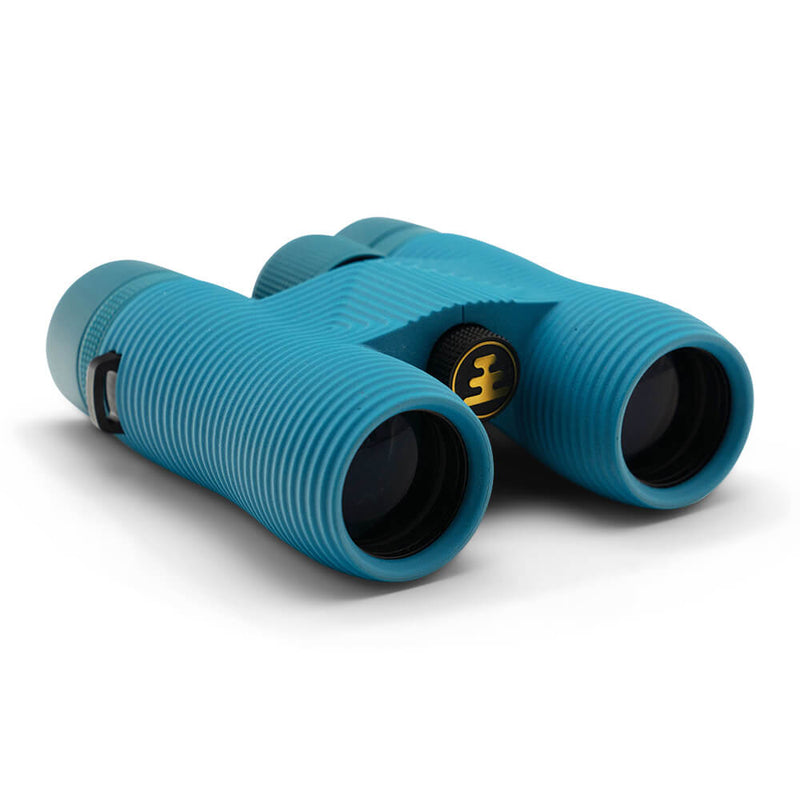
The Field Issue 42 8x42 is built with a 6-element, 4-group optical system with HiFi Fully Multi-Coated lenses and a field of view described in the spec sheet as "distortion free across the field" — 394 feet at 1,000 yards. That figure only means something if the glass actually delivers it edge to edge, not just through the center cone where any binocular looks good on a store shelf. The 42mm objective pulls in more light than a 32mm, which matters at the margins — dusk, dense canopy, low-contrast scenes — exactly the conditions where edge performance is hardest to maintain and most consequential to lose.

What This Means for the Scan
When the edges hold, glassing changes. Not dramatically — it doesn't feel like a revelation in the way that first looking through good glass does. It's quieter than that. You just stop re-centering so often. The frame feels roomier, even though the field of view is the same size. You start trusting the peripheral motion instead of waiting to confirm it in the center.
That's when scanning becomes instinct instead of work. The bird moves across the frame, and the frame keeps up. You catch things at the edge that you would have lost before — not because you got faster, but because the glass stopped lagging behind you.
The edge was always where the interesting stuff was. Now it's just easier to see it.
